

Best Batched Matcha Ratio for Cafes (Tested): How to Reduce Separation & Improve Consistency
A practical batching experiment for cafes and coffee shops
If you batch matcha in your cafe, you’ve probably asked this at some point:
What’s the best ratio for batched matcha?
Not for tradition. Not for ceremony.
But for real service. Speed, consistency, and minimizing how often you need to shake a bottle mid-rush behind the bar.
So we ran a batching experiment designed to answer one specific operational question faced by cafes, coffee shops, and matcha bars:
Is there a matcha-to-water ratio that minimizes separation and produces more consistent matcha shot pours during service?
This test builds on our existing batching framework for cafes. For a deeper dive into batching systems, water temperature, storage, and service workflows, explore our full guide on the blog.
TL;DR: Best Batched Matcha Ratio Takeaways for Cafes
Matcha doesn’t dissolve. It suspends, which means separation is inevitable
Changing the matcha dose, not just water volume, noticeably affects stability
There is no universal best ratio for batched matcha. Matcha type matters
The goal isn’t perfection. It’s finding a ratio you’re confident serving
The best batched matcha ratio is the one you’ve tested in your actual drinks
Why Batched Matcha Separates (and Why This Test Matters)
Matcha powder doesn’t dissolve in water like sugar or salt. It suspends.
That means:
Over time, gravity wins
Matcha particles settle
Batched bottles need to be shaken or stirred during service
Batching itself isn’t the problem. Improper batching systems and unexamined ratios are.
The goal of this experiment wasn’t to eliminate separation entirely. That’s unrealistic in real cafe environments. The goal was to reduce separation enough that batching becomes more stable and predictable during service, resulting in more consistently dosed matcha shots.
How to Read These Results as a Cafe Operator
This experiment is not about eliminating the need to shake batched matcha. Matcha always suspends and will always settle over time. Instead, the purpose of this test is to understand how different matcha-to-water ratios affect how quickly and how visibly separation appears between agitation during real service.
For cafe operators, that distinction matters. Ratios don’t change the fundamentals of sedimentation, but they do change how forgiving a batch is between shakes, how consistent pours are across tickets, and how batching performs in high- versus lower-volume environments. These findings are meant to support better batching decisions behind the bar, not prescribe a single “correct” ratio.
These findings are meant to support better batching decisions behind the bar, not prescribe a single “correct” ratio. With that context in mind, here’s how we designed the experiment.
Test, Compare, and Then Scale Your Ratio
These results are not meant to point you to a single ratio and stop there. They’re meant to encourage intentional testing.
Once you understand how different matcha-to-water ratios behave, the next step is to run the same test using your own matcha, water volumes, and temperatures. Small changes in dose or water can meaningfully affect separation timing, visual consistency, and how forgiving a batch feels during service.
We recommend testing:
Multiple matcha-to-water ratios, not just one baseline
Slightly different water volumes at the same matcha dose
Different water temperatures within matcha’s typical preparation range
Each variation in the same bottle, same environment, same hold time
For example, if your current baseline is 2 g, try testing 2.5 g and 3 g under identical conditions. Small changes in dose can meaningfully affect separation timing and how forgiving a batch feels during service.
Pay attention to:
How quickly separation becomes visible
How defined the sedimentation line is over time
How often the bottle needs to be shaken during service
How consistent pours feel across multiple drinks
Once you’ve identified a ratio and water temperature that performs well for your workflow, then scale it proportionally. Keep the same matcha-to-water relationship and preparation temperature, and increase batch size based on how many shots you need for a service window.
Testing first, then scaling, prevents overcorrecting. It also helps ensure your batching setup is intentional, repeatable, and aligned with how your bar actually operates.
The goal isn’t to find the “right” ratio. It’s to find the combination of matcha dose, water volume, and water temperature that works best for your matcha, your menu, and your service flow.
The Experiment Setup: How We Tested Batched Matcha Ratios
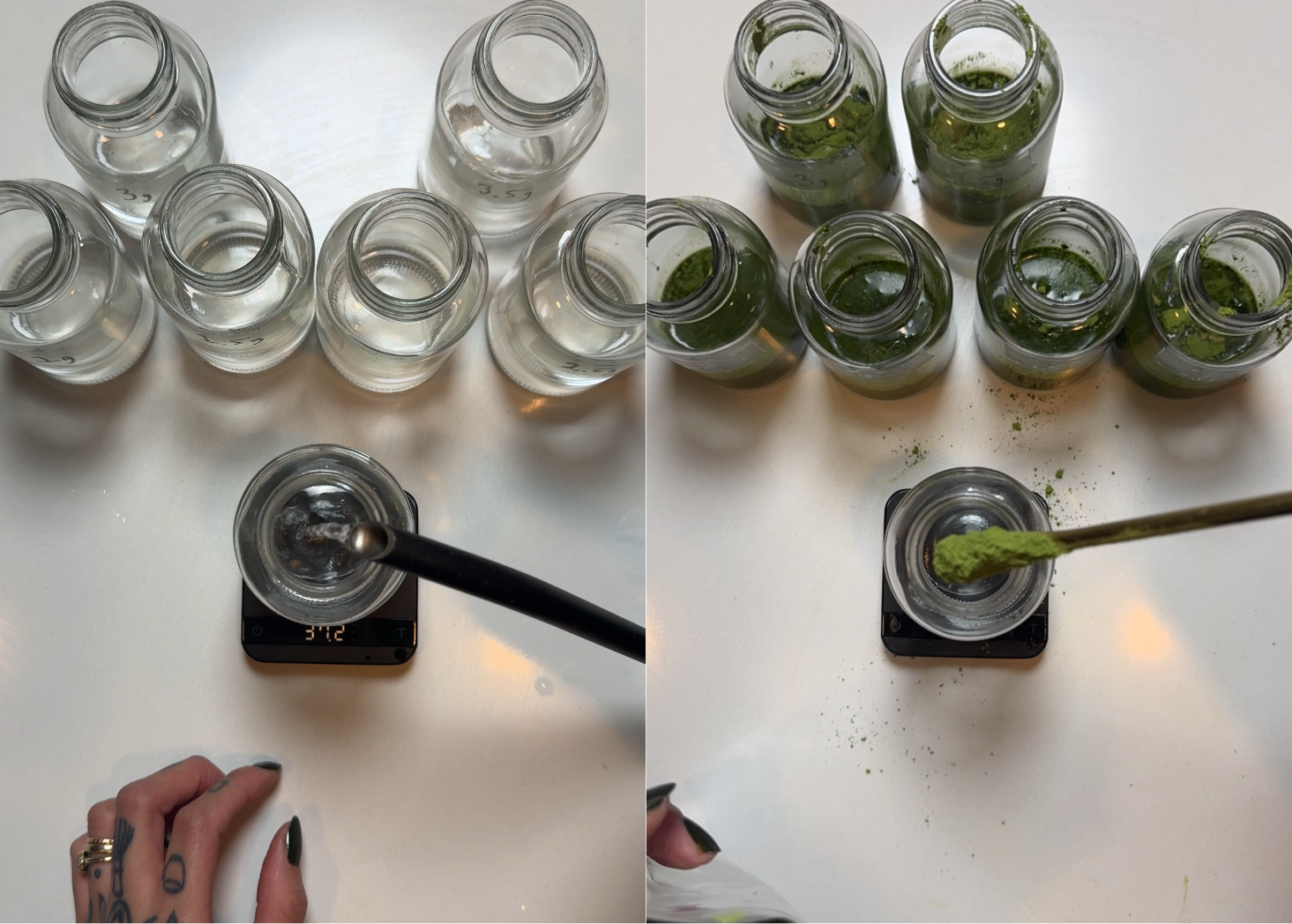
To isolate variables, we kept the water constant and adjusted only the matcha dose.
Water (room temperature)
1.25 oz water ≈ 37 g water
Note: This test was run with room temperature water for simplicity. Batching with warm to hot water within matcha’s ideal range (140°F to 175°F) can affect results. Higher temperatures may introduce slight evaporation, which can impact concentration at scale.
Matcha doses tested
1 g : 37 g → very dilute
1.5 g : 37 g → light, tea-forward
2 g : 37 g → standard cafe baseline
2.5 g : 37 g → balanced, fuller body
3 g : 37 g → bold, matcha-forward
3.5 g : 37 g → very concentrated
4 g : 37 g → extreme or specialty use
4.5 g : 37 g → ultra-concentrated, maximum stability, specialty applications
Each ratio was mixed the same way, bottled the same way, and held in identical conditions for four hours to observe how separation progressed over time.
Important context for cafes:
High-volume cafes may see little visible separation if batches turn over quickly. Slower cafes, where batches sit longer, are more likely to notice separation.
If separated batches are not properly reincorporated by shaking or stirring, this can lead to inconsistent customer experiences.
Important Context: There Is No One-Size-Fits-All Batched Matcha Ratio
Before getting into results, this needs to be said clearly:
There is no universal “best” batched matcha ratio for cafes.
Why? Because the matcha itself varies.
Factors that affect saturation and suspension include:
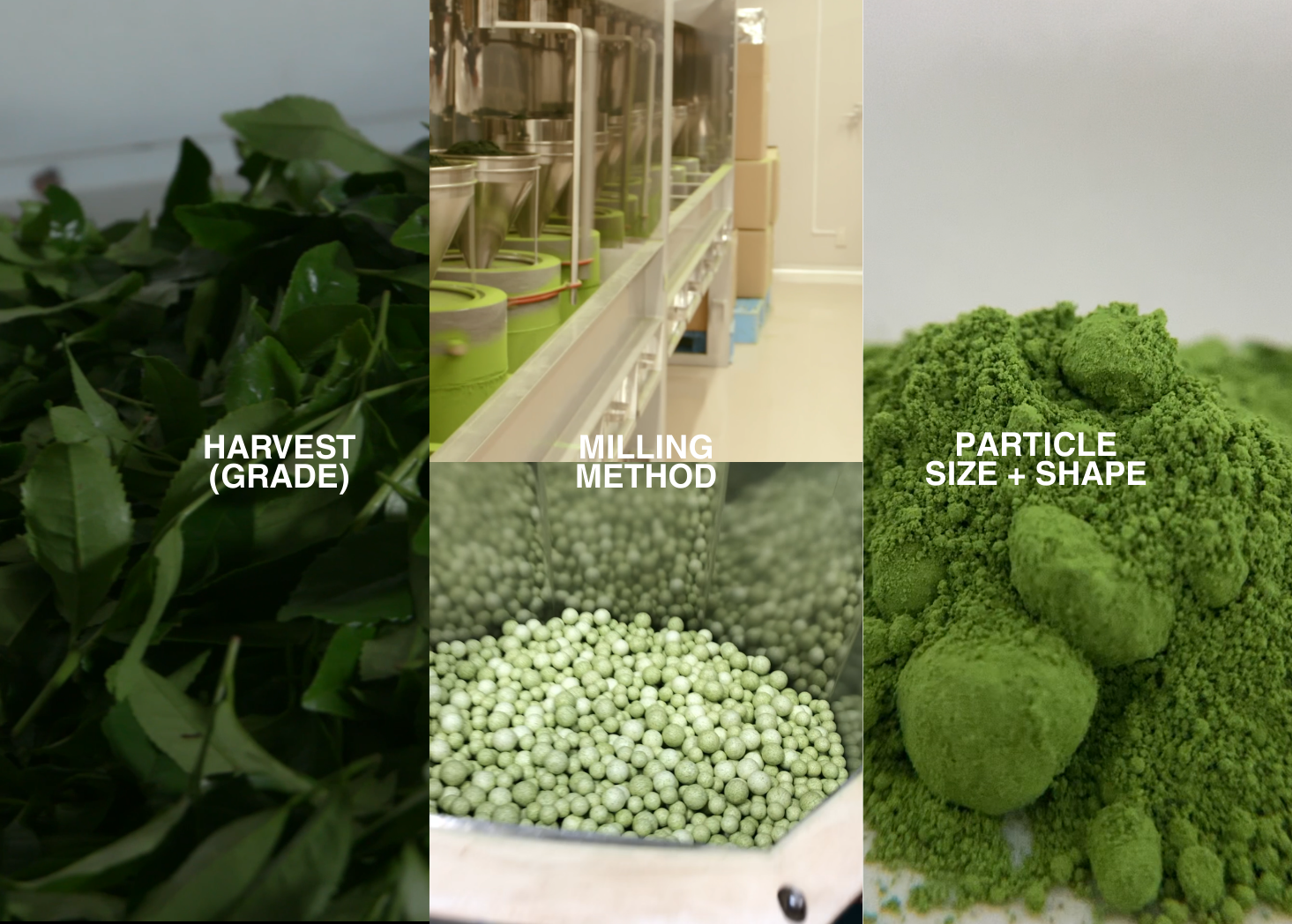
Harvest timing (first harvest often labeled ‘ceremonial’, later harvests labeled ‘culinary’)
Milling method (stone milled vs bead milled)
Particle size and shape, influenced by both harvest and milling
Cultivar which influences leaf structure and composition
Two different matcha offerings at the same dose can behave very differently in water.
This experiment isn’t about declaring a winner. It’s about giving cafe operators a framework to test, evaluate, and dial in ratios for their specific matcha, menu, and service flow.
Observations and Results
(Based on visual sedimentation after resting for one hour in identical conditions.)
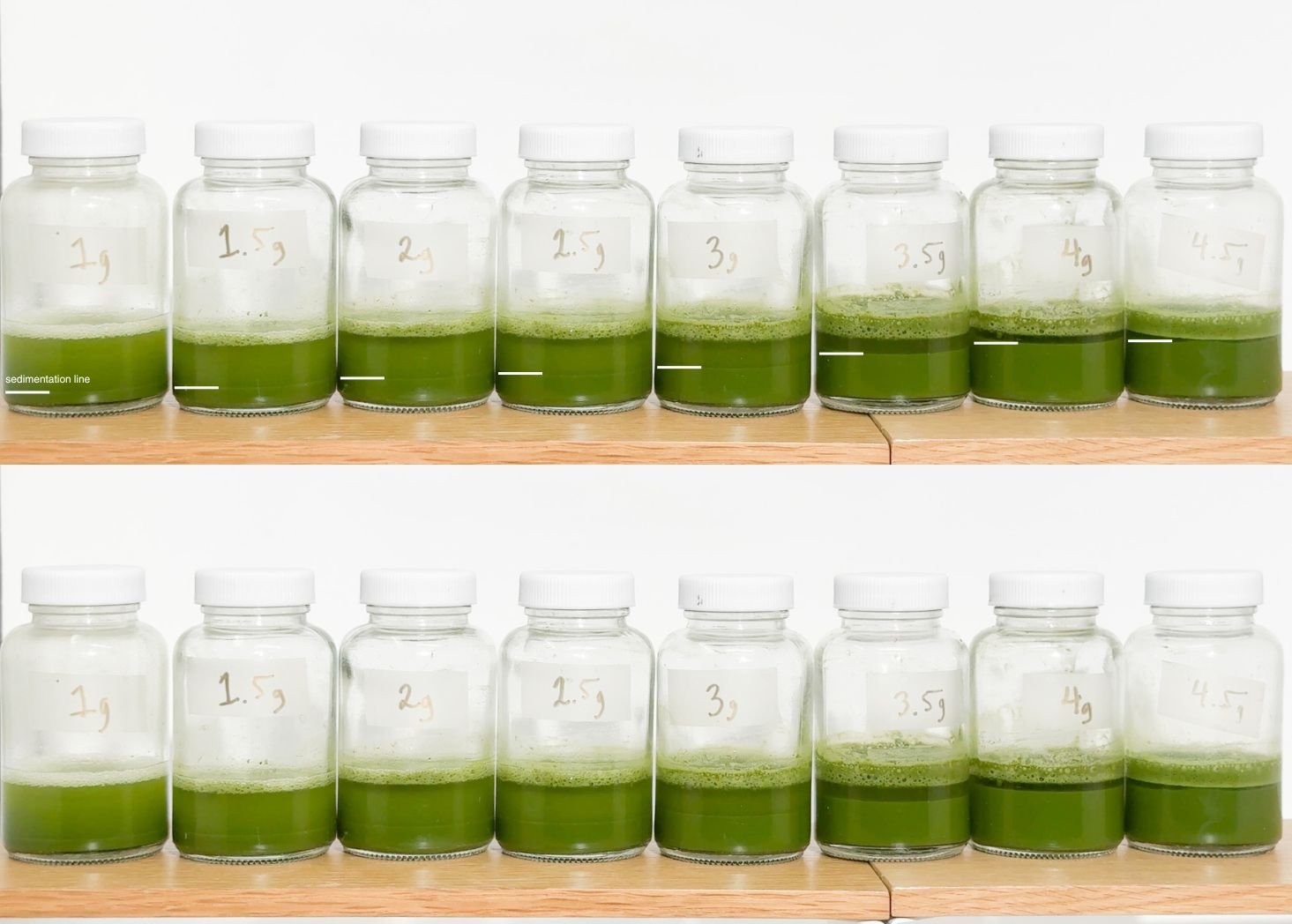
1 g Matcha : 37 g Water
Very pronounced sedimentation line
Clear water layer above settled particles
Largest separation zone of all samples
Lowest suspension stability
Interpretation:
Particles settle rapidly, leaving a clear upper layer of water. This ratio is visually unstable for batching and would require frequent agitation.
Best suited for: light matcha tea
1.5 g Matcha : 37 g Water
Slightly reduced sedimentation compared to 1 g
Clear separation still present
Suspension remains short-lived
Interpretation:
Marginal improvement over 1 g, but separation is still obvious and likely disruptive in batched service.
Best suited for: matcha americano, sparkling matcha with no flavor additions
2 g Matcha : 37 g Water
Noticeably higher sedimentation line
Less clear water above the settled layer
More uniform color throughout the bottle
Interpretation:
This ratio begins to behave like a workable batching baseline, with improved suspension and slower separation.
Best suited for: matcha shot flights, matcha macchiato, matcha cortado, iced matcha tea (americano)
2.5 g Matcha : 37 g Water
Sedimentation line continues to rise
Reduced clarity in the upper layer
More cohesive suspension overall
Interpretation:
The matcha still shows significant separation, this would still require frequent agitation during service.
Best suited for: hot matchaccino, hot matcha latte, iced sparkling matcha with flavor additions
3 g Matcha : 37 g Water
Sedimentation line is higher and less defined
Minimal clear water separation
Dense, consistent appearance
Interpretation:
Suspension stability improves at this ratio. Separation still occurs, but at a slower and less visually obvious rate.
Best suited for: hot matcha latte
3.5 g Matcha : 37 g Water
Subtle sedimentation line
Minimal water visible above settled particles
Significant improvement in the overall suspension
Interpretation:
Strong suspension stability and visual consistency, making this ratio well-suited for batching in slower service environments.
Best suited for: hot matcha latte, iced matcha latte where subtle matcha flavor is preferred (8 oz)
4 g Matcha : 37 g Water
Sedimentation line is faint and compressed
Water separation is minimal
Very dense, saturated appearance
Interpretation:
High stability with minimal visible separation. Visual consistency is excellent, though this density may significantly impact drink balance depending on format.
Best suited for: hot or iced matcha lattes (8–10 oz), iced matcha lattes with added flavors
4.5 g Matcha : 37 g Water
Near-uniform suspension across the bottle
Sedimentation line is barely distinguishable
Minimal to no visible water separation
Interpretation:
The most visually stable ratio tested. Particle settlement still occurs with minimal visual disruption.
Best suited for: iced matcha lattes where a stronger matcha flavor is preferred (8–12 oz)
Key Visual Takeaways
Increasing matcha dose consistently raises the sedimentation line
Higher ratios reduce visible water separation but do not eliminate settling
Stability improves gradually rather than abruptly
No ratio fully prevents sedimentation, reinforcing that matcha suspends rather than dissolves
Batching ratios are a stability dial, not a binary choice. Higher doses offer forgiveness and consistency, while lower doses demand tighter batching systems and more frequent agitation.
Looking Ahead
While 5 g of matcha to 37 g of water was not tested in this experiment, it may be an even more stable ratio with minimal water separation. Let us know if you’d like to see this tested in future content.
Batching Ratios and Drink Formats
Ideal ratios vary depending on drink format.
For example:
1–2 g may be ideal for matcha tea or matcha americano
2–3.5 g may work best for hot matcha lattes
3.5 g and higher may be better suited for iced matcha lattes
Milk type and milk ratio play a significant role here. Always factor them in when dialing recipes.
Batched Matcha Shots in Whole Milk
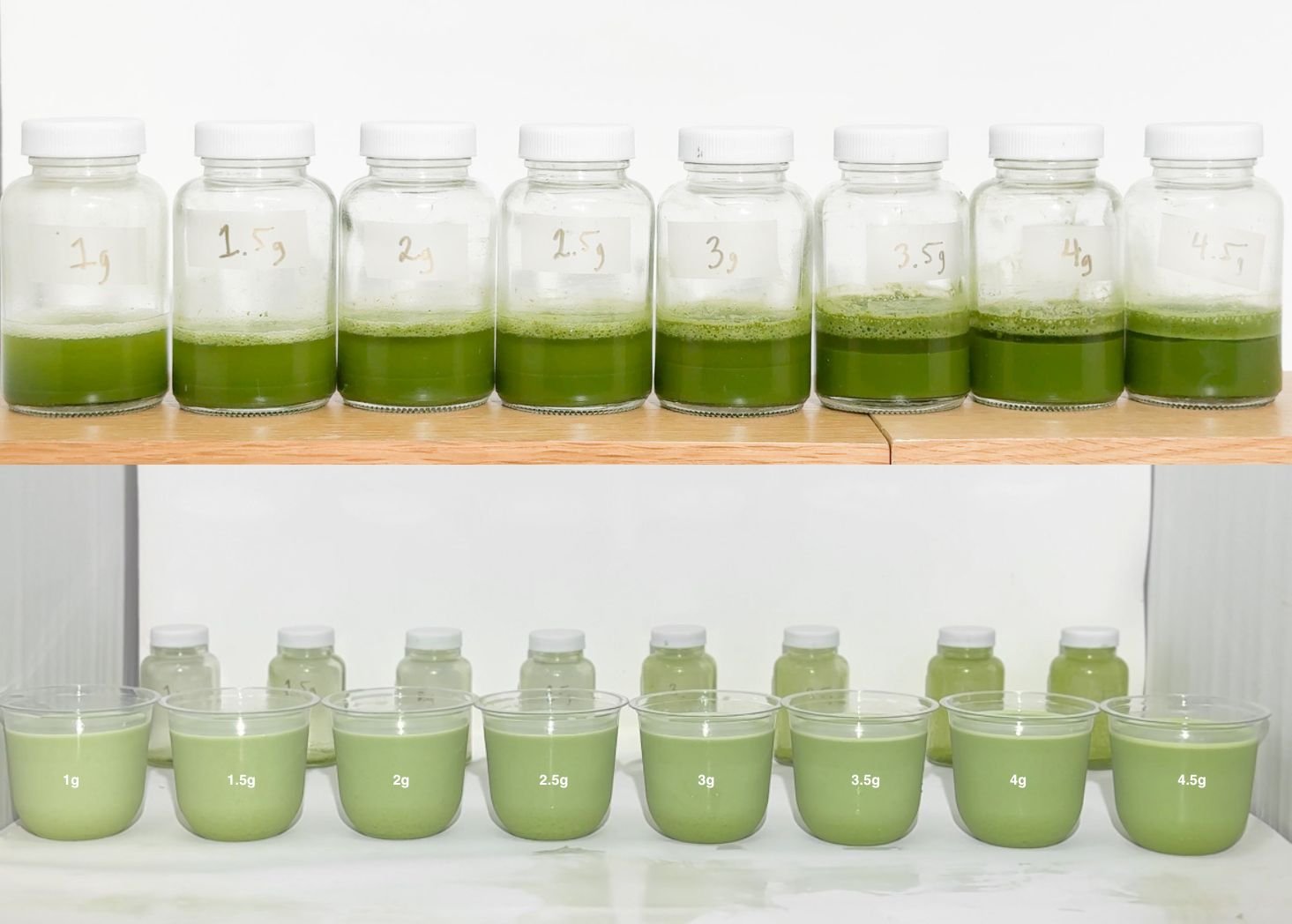
Top: batched ratios tested showing separation line between sediment (matcha) and water). Bottom: batched ratios poured into 8 ounces of whole milk to highlight variation in latte color.
After observing separation over four hours, we reincorporated each batch by shaking, then poured each shot over 8 oz of whole milk to compare latte color.
Why this matters:
Color is a common customer observation. If a matcha latte doesn’t look vibrant or strong enough, customers may assume it’s low quality or improperly dosed, even if the flavor is balanced.
This test was done using batched matcha shots that had been sitting for several hours and were visibly oxidized. Despite that, differences in overall latte color were still noticeable. We recommend repeating this test with freshly batched shots for the most accurate comparison.
How to Apply This in Your Cafe
This is the part that matters most.
Run this test yourself. Then scale it.
Pick a water volume that works for your bar flow. We chose ~1.25 oz (37g), however, matcha shots are typically made between 1.25 oz and 2 oz.
Test multiple matcha doses
Observe separation over time
Taste each ratio in your actual drinks
Use freshly made batches for tasting, not samples that have been sitting and oxidizing
Test different milk types and ratios
Test different sweetness levels and drink add-ons like syrups, purees, cream tops, etc.
Fine-tune based on:
Your standards
Your customers’ preferences. Ask a few trusted customers for honest feedback. Instead of “Do you like it?” or “What do you think?”, try “What would make this better?” This phrasing invites more thoughtful, useful input and gives people permission to be honest.
This is the fun part. This is where recipes become yours.
Why We’re Not Prescriptive With Recipes
We don’t love telling cafes, “This is the correct ratio.”
Your cafe isn’t our cafe (we don’t have a cafe, but you get what we’re saying).
Your matcha isn’t our matcha.
Your customers aren’t our customers.
The real goal isn’t optimization for optimization’s sake. It’s landing on a ratio you’re confident serving every day.
While it may feel tempting to have someone prescribe the best batching ratio, fine-tuning this to your preferences is often where meaningful differentiation happens. This is where strong, intentional matcha programs are built.
How to Scale a Batched Matcha Ratio Once You Dial It In
The example below is meant to illustrate scaling mechanics, not recommend a specific ratio.
Once you’ve landed on a ratio you’re happy with, the next step is scaling it in a way that preserves consistency, stability, and flavor.
The key is to scale proportionally, not intuitively.
Start With Your Tested Base Ratio
Use the exact ratio you tested. For example:
1 g matcha : 10 g water per shot
This ratio becomes your anchor. Every larger batch should be a direct multiple of it.
Scale by Yield, Not Estimation
Decide how many shots you want your batch to produce, then multiply both matcha and water accordingly.
Example:
10 shots at 1 g : 10 g
Matcha: 10 g
Water: 100 g
Avoid rounding water or matcha independently. Small deviations compound quickly at scale and can impact suspension stability and flavor balance.
Match Batch Size to Service Volume
Smaller batches:
Turn over faster
Show less visible separation
Work well with lower-dose ratios like 1 g : 10 g
Larger batches:
Sit longer
Require more frequent agitation
Benefit from clear shaking or stirring protocols
With lower-dose ratios, batching smaller and more frequently is often more effective than making one large batch.
Even with a well-dialed ratio, reincorporation before service still matters.
Recheck Water Temperature at Scale
If you tested with room temperature water, be aware that scaling with warm or hot water can slightly change concentration due to evaporation. After scaling, reassess:
Visual suspension
Flavor intensity
Shot consistency
Always Validate in the Drink
After scaling, taste the batched matcha in your actual menu drinks:
With your milk types and ratios
At your standard sweetness levels
At serving temperature
Even when the math is correct, perception can shift once the ratio is scaled.
Document and Train
Once the ratio is finalized:
Document the ratio and batch size
Specify water temperature
Define shaking or stirring frequency
Train staff on proper reincorporation before service
This is how a ratio becomes a system, not a variable.
Your Turn
If you’re batching matcha right now:
What ratio are you using?
What made you land there?
Drop it in the comments. Let’s compare notes.
